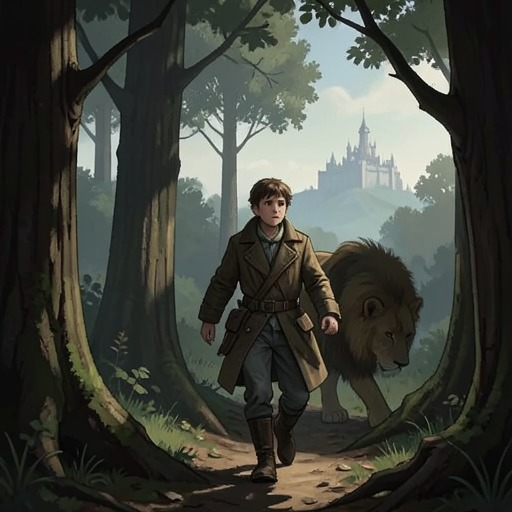
Aslan and Rabadash
The Horse and His BoyAslan and Rabadash meet in a confrontation that makes the prince’s threatened violence answerable to a higher judgment: Aslan gives him repeated chances to yield his pride and anger, then transforms him into a donkey when he refuses. The sentence is not simply vengeance. It offers a defined route back to human form while placing a lasting limit on Rabadash’s freedom, making mercy inseparable from consequence.
The confrontation
Rabadash is brought before the gathered company, where Aslan appears without anyone seeing him arrive and walks between the prince and his accusers. Aslan addresses him directly, warning that his doom is near but still avoidable. He tells Rabadash to abandon his pride and anger and accept the mercy of the good kings. The warning presents submission not as defeat at the hands of an enemy, but as a choice still available before punishment takes effect.
Rabadash answers with contempt rather than reconsideration. He calls Aslan a demon and threatens destruction upon Narnia, invoking Tash and claiming that scorpion-shaped lightning will fall on his adversary. Aslan remains quiet, but makes the danger unmistakable: the doom is now at the door and has lifted the latch. The language narrows the space for choice; Rabadash has been warned, and his next response will determine whether the threatened consequence arrives.
Instead of accepting mercy, Rabadash renews his threats and vows that he will never stop until he has dragged the queen to his palace by her hair. Aslan declares that the hour has struck. The sequence gives the transformation a clear moral and dramatic cause: the prince is not changed at the first warning, but after he rejects the offered mercy and persists in violent defiance.
Transformation and reversal
Aslan’s declaration is followed by a bodily change that overturns Rabadash’s power and the fear on which it depends. The prince had tried to intimidate those around him with grotesque expressions and the movement of his ears, gestures that had frightened people in Calormen. In Archenland, however, they do not produce the same terror. When the transformation begins, the gathered company laughs at the incongruity of his changing face and limbs; Rabadash’s familiar means of commanding fear becomes the spectacle of his helplessness.
His ears lengthen and grow gray hair; his face extends, his nose becomes the dominant feature, and his arms lengthen until his hands have become hooves. His clothes disappear, and the prince is left unmistakably a donkey. His human speech lasts only slightly longer than his human shape. He begs for mercy and protests that he would accept even becoming a horse rather than a donkey, but his words collapse into a bray as the change finishes. The reversal strips away rank, threat, and eloquence at once.
The scene also turns Rabadash’s own religious language back upon him. He has invoked Tash as a source of power and threatened Aslan in Tash’s name; Aslan’s sentence makes the temple of Tash the place where Rabadash may be healed. The prince’s appeal does not shield him from judgment. Instead, the punishment directs him toward the very religious site he claimed as an emblem of his authority.
A sentence bounded by mercy
Aslan explicitly describes the judgment as justice mixed with mercy and says that Rabadash will not remain an ass forever. At the great Autumn Feast of that year, Rabadash must stand before Tash’s altar in Tashbaan. There, in the sight of the city’s people, his donkey shape will fall away and he will be recognized as Prince Rabadash. Restoration is therefore public as well as bodily: the return to human form will occur before those who have seen or might hear of his degradation.
The reprieve has a strict condition. For the rest of his life, Rabadash must not travel more than ten miles from Tashbaan’s great temple. If he crosses that boundary, he will immediately become a donkey again, and after that second transformation there will be no return. The sentence permits restoration but denies him the liberty to resume his former life without restraint. Its precise distance and lifelong duration make the limit part of the punishment, not a temporary warning.
The relationship’s significance
Aslan’s conduct toward Rabadash joins authority to restraint. He does not transform the prince at the first sign of hostility: he warns him, identifies the course by which he may avoid his doom, and urges him to accept mercy. Rabadash’s refusal makes the eventual punishment consequential rather than arbitrary. Yet the sentence preserves a possibility of healing and specifies what Rabadash must do to receive it, rather than treating his humiliation as the sole end of the encounter.
When Aslan disappears, the company is left with brightness in the air, joy in their hearts, and the donkey before them as tangible evidence that the encounter was no dream. King Lune then forgets his anger at the sight of his enemy in this condition. The outcome extends beyond the prince’s transformation: Aslan’s judgment changes how Rabadash can be treated and gives his defeated opponents reason to respond with compassion, even while the severe terms of the sentence remain in force.